 Panacea Bio ChemReceptor Pharmacology · Monograph
PBC-NPY2R-01 · REV 2026-07
Panacea Bio ChemReceptor Pharmacology · Monograph
PBC-NPY2R-01 · REV 2026-07
Panacea Bio ChemReceptor Pharmacology · Monograph
PBC-NPY2R-01 · REV 2026-07
Panacea Bio ChemReceptor Pharmacology · Monograph
PBC-NPY2R-01 · REV 2026-07
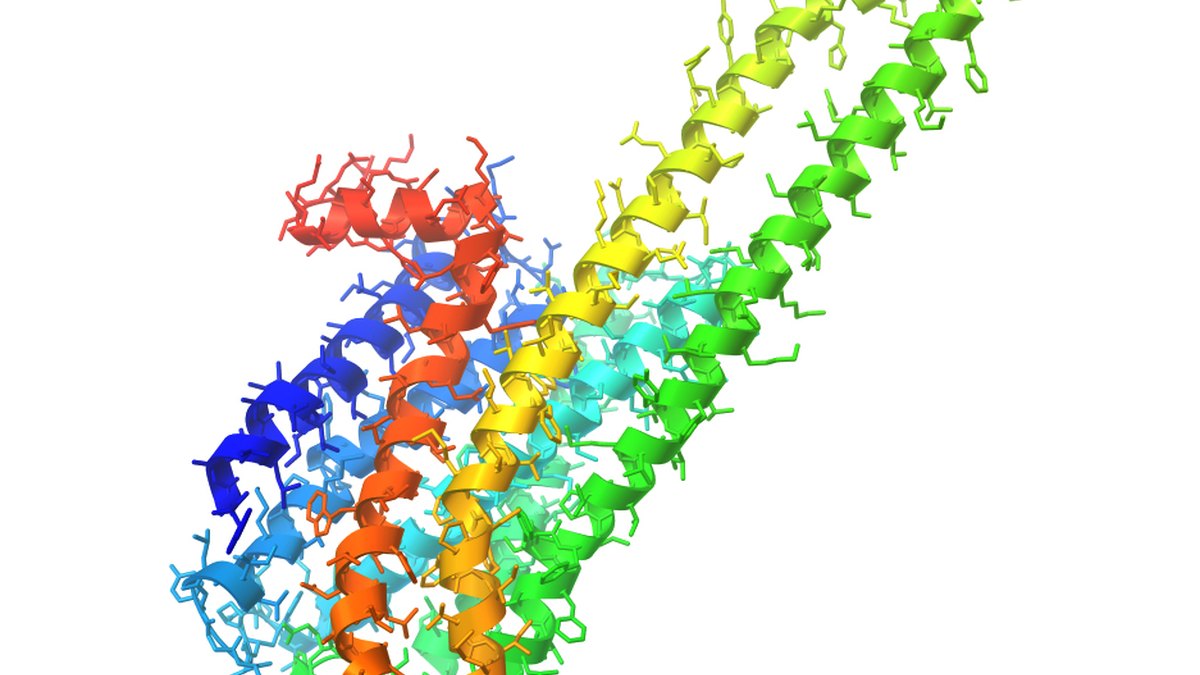
The Neuropeptide Y Y2 receptor (NPY2R) is a class A, Gi/o-coupled G protein-coupled receptor for neuropeptide Y (NPY) and peptide YY (PYY). Its defining role is as a presynaptic autoreceptor1 — a volume knob a neuron places on itself, so that once enough signal has been sent, further release is gently turned down. Fed by the gut hormone PYY3-36, the same receptor carries one of the body's own satiety signals from the intestine to the brain, which is why Y2 agonism has become an inviting direction for metabolic health.
Neurons talk to each other with chemical messengers. Some receptors sit on the receiving cell and pass a message onward. The Y2 receptor mostly does something cleverer: it sits on the sending cell's own terminal as an autoreceptor, and when it detects that its neuron has already released plenty of messenger, it tells that neuron to ease off. It is negative feedback built into the wiring — the nervous system listening to itself and staying in balance.
Its natural keys are two closely related 36-amino-acid peptides. Neuropeptide Y is among the most abundant peptides in the mammalian brain, first isolated from porcine brain by Kazuhiko Tatemoto and Viktor Mutt in 19822; its name comes from a tyrosine (single-letter Y) at each end of the chain. Peptide YY is its cousin, made in the gut. Both belong to the pancreatic-polypeptide family and share a hairpin "PP-fold." The Y2 receptor is unusual in that it prefers the C-terminal fragments of these peptides — chiefly PYY3-36 and NPY13-36 — rather than the full intact chains, a preference that turns out to matter a great deal downstream.
Here is where the Y2 receptor becomes fascinating. When you finish a meal, L-cells in the lining of the lower gut release PYY in proportion to the calories you just ate. In the bloodstream an enzyme, dipeptidyl peptidase-4 (DPP-4), clips the first two residues off PYY(1-36) to make PYY3-36 — and that small edit sharpens the peptide's aim squarely at the Y2 receptor. PYY3-36 travels to the brain's appetite hub, the hypothalamic arcuate nucleus, where it engages Y2 autoreceptors on the very neurons (the NPY/AgRP neurons) that otherwise drive hunger — and quiets them. The felt result is fullness.
In 2002, Rachel Batterham and colleagues showed in Nature that giving PYY3-36 at a natural, meal-sized level reduced food intake in both rodents and people, and traced the effect to the Y2 receptor3. It was a vivid demonstration that a hormone made in the gut can speak directly to the brain's hunger circuitry. The same thread helps explain a long-standing puzzle: why some people lose their appetite after bariatric surgery. Procedures such as Roux-en-Y raise circulating PYY and other gut hormones, so the brain hears a stronger, earlier "enough" signal.
NPY and PYY act through a small family of receptors, each with its own accent. Reading them side by side shows why Y2 stands apart — it is the feedback-and-satiety member.
| Receptor | Where it mostly sits | Prefers | Characteristic role (beneficial view) |
|---|---|---|---|
| Y1 | Postsynaptic | Intact NPY / PYY | Supports feeding drive, calming (anxiolytic) tone and vascular balance |
| Y2 | Presynaptic autoreceptor | C-terminal fragments (PYY3-36, NPY13-36) | Feedback restraint of release; carries the gut-to-brain satiety signal |
| Y4 | Peripheral & central | Pancreatic polypeptide (PP) | Reads a separate pancreatic satiety hormone; complements Y2 |
| Y5 | Postsynaptic (hypothalamus) | Intact NPY | Works alongside Y1 in appetite and energy balance |
A fifth subtype, y6, is non-functional in humans, so the working human family is Y1, Y2, Y4 and Y5.
The Y2 receptor is broadly distributed, which is why its influence reaches well beyond appetite:
Genetically, human NPY2R encodes a 381-amino-acid, seven-transmembrane receptor and maps to chromosome 4q32.1, close to the Y1 receptor gene4. Like its relatives it couples through Gi/o proteins to lower intracellular cAMP and damp calcium entry at the nerve terminal — the molecular basis of its "ease off" message.
Because the Y2 receptor carries a natural satiety signal, activating it works with the body's own regulation rather than overriding it. That is the appeal for metabolic health: a long-acting PYY3-36-like Y2 agonist could reinforce the fullness signal the gut already sends after eating, and several groups are pairing Y2 agonism with GLP-1 agonism to let two complementary gut-hormone pathways add up. The unsolved part is delivery and durability — PYY3-36 is a small, fragile peptide, easily trimmed further by the very proteases that made it, and easily unfolded or oxidised during manufacture and storage. Keeping such a molecule intact from synthesiser to syringe is a genuine frontier in its own right.
Panacea Bio Chem researches this sphere from the preservation side: its ongoing work treats the fragile signalling peptides of the NPY/PYY family — molecules whose very identity, like PYY3-36, is defined by a precise proteolytic edit — as a case study in protecting sequence integrity through synthesis, drying, storage and reconstitution. The direction its research points is a peptide that reaches the patient exactly as it left the bench.
Several Panacea technologies bear on that goal. Cryolapse™ — gentle cryogenic freeze-drying → removes water without the flash-boiling that can shear a delicate chain; TgShift™ — raising the glass-transition ceiling → keeps the dried cake stable; and OxyDeplete™ — headspace oxygen removal → guards oxidation-prone residues. The Lyoprester® dual-chamber cartridge → then lets the dried peptide meet its diluent cleanly, at the point of use, with the whole choreography watched in real time by S3Pulse™ — the process brain →. The exact procedures, parameters and sequences remain proprietary to Panacea Bio Chem and are not disclosed; the outline is here, the recipe stays behind the door.
What does NPY2R stand for?
NPY2R is the gene and receptor name for the
Neuropeptide Y receptor Y2 — the type-2 receptor for neuropeptide Y and peptide YY,
a Gi/o-coupled GPCR that acts mainly as a presynaptic autoreceptor.
Why is PYY3-36 selective for the Y2 receptor?
The enzyme DPP-4 removes the two
N-terminal residues of PYY(1-36); the resulting C-terminal-weighted fragment, PYY3-36, is
the form the Y2 receptor prefers, so the edit sharpens the peptide's aim at Y2.
Is Y2 agonism only about appetite?
No. Because Y2 receptors sit in the
hippocampus, hypothalamus, sympathetic neurons and periphery, the receptor also touches
excitability, stress, cardiovascular balance and bone — appetite is simply its most famous
role.
Recent developments in the field — refreshed 2026-09-16 by Panacea Bio Chem.
The Panacea Technology Universe
Proprietary Panacea Bio Chem Ltd technologies, invented by Bogdan Dicoias — what each one does, and why it leads its class.
 Lyoprester®The only dual-chamber cartridge that is autoreconstitution-enabled, vacuum-sealed and argon-fillback.lyoprester.com ↗
 P-EARLs™Panacea-Engineered Aseptic Reconstitution Liquid(s) — each tuned to the peptide it wakes.p-earls.com ↗
 Peptourbillon™The layered peptide formulation architecture — single- or multi-layer, never a blend.peptourbillon.com ↗
 RF Tunnel™The RF-formed central channel through the cake.rftunnel.com ↗
 TgShift™Raises the cake’s glass-transition temperature with RF — instead of chilling below it.tgshift.com ↗
 Cryolapse™Cryogenic pressure collapse under S3Pulse™ control — vapour redistributed through the whole cake, not its surface, impeding crust formation.cryolapse.com ↗
 LyoLevit™The cake levitates and spins in high orbit — driven by ultrasound and RF.lyolevit.com ↗
 Lyochrysalis™The integrated chamber housing the whole drying stack.lyochrysalis.com ↗
 S3Pulse™The control brain for every piece of Panacea hardware.s3pulse.com ↗
 Liquiprester™The single-liquid cartridge engineered so multiple peptide APIs coexist in one shared vehicle.liquiprester.com ↗
 Syntheseract™Continuous-flow peptide synthesis in a special, very fast and economical way.syntheseract.com ↗
 CFSPPS™Continuous-flow solid-phase peptide synthesis, written as its own category.cfspps.com ↗
 OxyDeplete™Degassing plus no-headspace doctrine — the oxygen-starved seal.oxydeplete.com ↗
 ArgonLock™The final inert-atmosphere lock under argon.argonlock.com ↗
 RedoxVault™Separation, not merely suppression — redox isolation in lipid micro-reservoirs.redoxvault.com ↗
 PleniDose™The shared filling gantry — one machine filling both the dual-chamber Lyoprester and the liquid Liquiprester.plenidose.com ↗
 IncreSure™The dose-metrology layer — verified API per pen increment.incresure.com ↗
 ElimiVoid™Front-void elimination without touching the metered dose.elimivoid.com ↗
 Cryoviscous™The characterised cold, high-viscosity, low-mobility conditioning state.cryoviscous.com ↗
 Vana Machine™Vacuum Assisted Needle Accessory — vacuum conditioning and plunger-locking for the cartridge.
 EZnject™The disposable auto-injector pen built around the Lyoprester.panaceaeznject.com ↗
 Dicoias ΨThe computed-chemistry advisory — every substance reduced to a vector across physical, electronic and formulation space.dcppsi.com ↗
 SealoPrester™Aseptic Cartridge Closure System — Seal o’ Precision + Sterility.sealoprester.com ↗
 Peptidic LiquidThe peptide formulation in solution — the active plus its buffers, cryoprotectants, lyoprotectants and scaffolders.peptidicliquid.com ↗
 DiastolVAC™Biomimetic diastolic vacuum control — the pneumatic circulatory system of the machine: pumps, valves and sensors as one ensemble.diastolvac.com ↗
The publications indexed in PubMed in the last 30 days for NPY2R / neuropeptide Y Y2 receptor research already appear in Trending above — the next most recent in the field, refreshed weekly.